The E-mini S&P 500 future (@ES) is one of the most heavily traded futures contracts in the world, and it attracts more than its share of chart-pattern guesswork. I’d rather let a computer do the deciding. Both of my ES strategies started as an observation, got turned into exact rules, and had to survive a back-test with estimated commissions and slippage before I traded them.
They work very differently. One is a day-trading system that is flat by the close. The other is a swing system that holds for days. For each, here’s the idea, the rules in plain English, and the catch, because every strategy has one.
Why ES suits rules-based trading
- It’s deep and liquid. On a normal day you can get in and out quickly with tight spreads, which keeps the gap between a back-test’s modeled costs and your real fills smaller than in thin markets.
- It trades nearly around the clock. ES trades on CME Globex from Sunday 5:00 p.m. to Friday 4:00 p.m. U.S. Central time, with a one-hour break each afternoon.
- Shorting is as easy as buying. Selling a future short needs no stock borrow, so a system can trade both directions with the same rules.
- You can size it down. The Micro E-mini (@MES) is one-tenth the size of @ES ($5 times the index instead of $50), so the same signals can run on a smaller account.
The flip side is leverage. A small move in the index is a big move in your account, in both directions, so position sizing matters more here than almost anywhere.
1. Day trading ES: intraday patterns, flat by the close
The idea: the S&P 500 repeats certain behaviors inside the trading day. Trade those patterns long and short, and close everything before the session ends so nothing is held overnight.
The patterns my ES Day Trading strategy looks for:
- Opening gaps, when ES opens well away from the prior close.
- Momentum thrusts, sharp moves that tend to keep going for a while.
- Retracements to dynamic levels, pullbacks to levels that adjust with the day’s action.
- Rally and breakdown reversals, when a push higher or lower fails and turns around.
Each pattern is defined mathematically with wide tolerances, so the rules aren’t tuned to one exact setting (that’s how you avoid a curve fit). Position size adapts to current volatility, a volatility-based stop sits on every trade, and every position is closed by the end of the session.
The catch: day trading lives and dies on costs and fills. A system that trades often pays commissions and slippage often, and your real fills can differ from the modeled ones. It also has to be running while the market is open.
The strategy was written and tested in 2016 and has traded in real time since:

Hypothetical back-test · @ES E-mini S&P 500 futures (5-min intraday) · 29 years, 1997–2026 · positions sized on a $25,000 portfolio model with compounding · includes estimated commissions ($1.50/contract) and slippage ($6.50/contract), and models intrabar fills at 1-minute resolution. All positions close by end of session; no overnight exposure. Futures are leveraged: the model commits only a fraction of the account to margin, but leverage magnifies losses as well as gains. Annual return is the compound annual growth rate (CAGR) of the modeled account over the test period. Hypothetical results have inherent limitations; past performance is not necessarily indicative of future results.
2. Swing trading ES: trend plus mean reversion
The idea: let the trend choose the direction, then wait for price to stretch too far against it and trade the snap back.
- Confirm the trend. A moving-average filter decides whether the system can only buy or only sell short.
- Wait for the stretch. It enters when ES pushes past a threshold away from its short-term range, measured in volatility, so it adapts to quiet and fast markets.
- Exit on the reversion. It closes the trade as ES returns toward its average, with a volatility-based stop on every position.
It’s the same engine I run on SPY, tuned for futures. The full walk-through is in E-mini (ES) Swing Trading: The Futures Version of My S&P System.
The catch: positions are held overnight, so the full exchange margin applies, not the lower intraday margin brokers advertise for day trades. One standard contract ties up a large share of a smaller account, which is what the Micro E-mini is for. Overnight holds also carry gap risk: the market can open well away from where it closed.
Written and tested in 2016, traded in real time since:
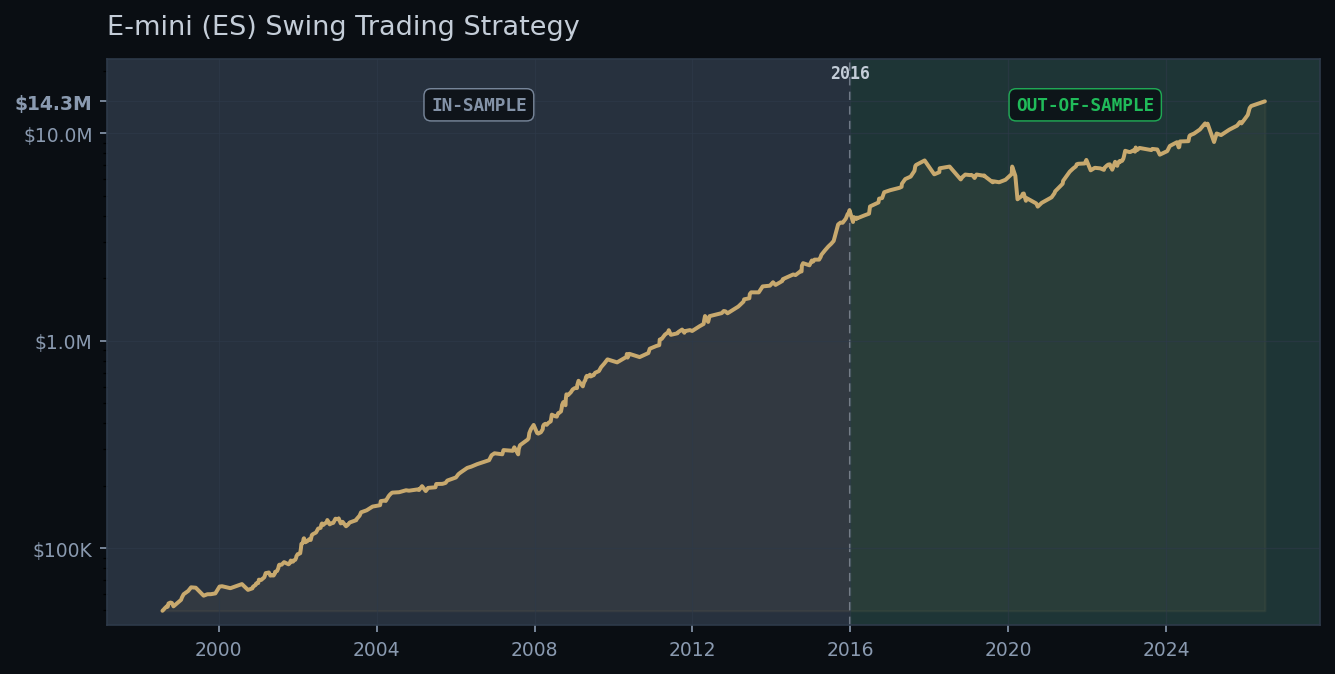
Hypothetical back-test · @ES E-mini S&P 500 futures (daily) · 1998 to 2026 (28-year back-test) · $50,000 initial capital, positions sized at 3.5% account risk per trade with profits compounding (grew to a maximum of 372 contracts) · includes estimated commissions ($1.50/contract) and slippage ($12.25/contract). This strategy holds positions overnight, so every position must be covered by the full exchange performance bond, not the smaller intraday margin brokers advertise for day trades. The back-test does not model that: TradeStation does not enforce a performance bond, and the optional margin guards shipped with the code (useMarginCap and useMarginExit) were both off for this run, so position size was limited only by volatility and account risk. Modeled at 8% of contract notional, the margin required would have averaged about 24% of the account and peaked near 71% on the largest position. Exchange margin is set by CME, changes without notice and rises in volatile markets; at recent index levels a single contract alone posts more than half of a $50,000 account. Annual return is the compound annual growth rate (CAGR) of the modeled account over the test period. Hypothetical results have inherent limitations; past performance is not necessarily indicative of future results.
How the two compare
| Day trading | Swing trading | |
|---|---|---|
| What it trades | Repeatable intraday patterns | Stretched pullbacks within the trend |
| Direction | Long and short | Long and short, with the trend |
| Typical hold | Within one session; flat by the close | Days, held overnight |
| Margin | Intraday margin (set by your broker) | Full overnight exchange margin |
| Hardest part | Costs and fills | Overnight gaps and margin |
| Read more | ES Day Trading | ES swing walk-through |
Because one is intraday and the other holds for days, they don’t always win and lose at the same time. That’s the case for understanding both, even if you only trade one.
Prefer an ETF?
The swing logic also runs on SPY, with no futures account needed: the SPY long/short swing strategy and the free 3-line SPY strategy. Shorting SPY does need a margin account.
Before you trade any ES strategy
- Test it yourself. Back-test the rules, then check them on data they never saw. Here’s how to backtest a trading strategy and why out-of-sample testing matters.
- Size to volatility, and start small. The position size calculator covers the ATR-based approach, and the Micro E-mini makes small size possible.
- Know your margin. The exchange sets the minimum, your broker can require more, and both can rise without notice when markets get volatile.
- Mind the calendar. ES contracts expire every March, June, September and December, so positions held across an expiration have to be rolled to the next contract.
Simple, tested rules beat a chart full of guesses. Pick the style that fits how you trade, test it, and let the rules do the deciding.
Educational only; not investment advice. RelaxedTrader is not a registered investment advisor or broker-dealer. Futures trading involves substantial risk of loss and is not suitable for every investor. Back-tested and hypothetical results have inherent limitations; past performance is not indicative of future results.