SPY Swing Trading Strategy
Trend-following plus mean-reversion for the S&P 500 ETF. Written in 2016 — still trading live.
- ✓ EasyLanguage source code (.ELD)
- ✓ TradeStation workspace (.TSW)
- ✓ Quick start guide
- ✓ Back-test report
- ✓ Lifetime updates — free
- ✓ Q&A access with Kurt
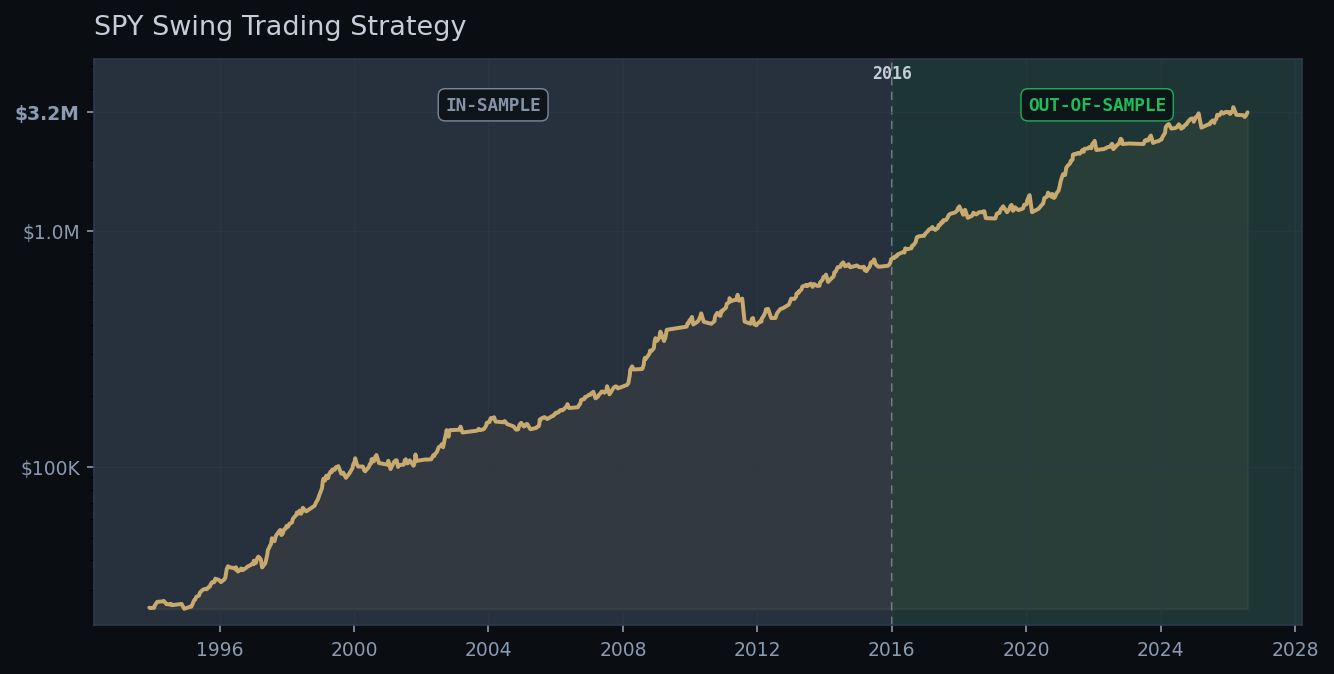
A full back-test report — profit factor, net profit, drawdown, win rate and trade statistics, with modeled commissions & slippage — is included with your purchase. Hypothetical results have inherent limitations; past performance is not necessarily indicative of future results.
The logic behind the edge.
SPY Swing Trading pairs two durable market forces — trend-following and mean-reversion — into one adaptive system for the S&P 500 ETF. It first confirms the macro trend in SPY, then waits for price to stretch well beyond its short-term range before entering long or short in the trend direction, closing the trade as price reverts toward its average. Volatility-based position sizing scales exposure to current conditions, and an optional, user-adjustable volatility stop can be switched on for longs and shorts (it is off in the shipped settings and in the published back-test). Written in 2016 and live-traded since, with no re-optimization.
- Confirms SPY is in a sustained uptrend or downtrend (the trend filter).
- Enters long or short when price pushes past a volatility-based threshold away from its short-term range.
- Exits as price reverts to its average; an optional volatility-based stop is off by default.
Every strategy in the RelaxedTrader store is back-tested across a minimum of 10 years of historical market data, with estimated commissions and slippage, before a line of code is sold. If it doesn't hold up under rigorous testing, it doesn't make it to the store.
You receive the complete, fully-annotated EasyLanguage source code — no black boxes, no compiled files. You can read every line, understand every decision, and modify it as your knowledge grows.
New to this approach? Read the full breakdown in our Trading School: SPY Long/Short Swing Trading: Trend-Following Meets Mean Reversion →
What you get with every purchase.
Common questions.
Yes. It's a standard TradeStation strategy: once it's on its chart, turn on automation in the strategy settings (Studies → Edit Strategies, then enable order generation and automation) and choose the account it trades, either a live account or a TradeStation simulated account. Run it in simulation first and compare its fills with the back-test before going live. Automation only runs while the platform is open and connected, and an automated strategy should never be left unsupervised.
It has an optional volatility (ATR) stop for both longs and shorts, but it ships switched off (the input useStops is false) and the published back-test was run without it, so every trade there exits on the mean-reversion rule. To use one, set useStops to true and choose its distance with stopAtr, then re-run the back-test, because a stop changes the results.
Yes. It's a swing system that holds SPY shares, long or short, for days at a time. Short trades need a margin account (or an inverse ETF such as SDS), and the published figures assume a margin account too; see the capital note next to the Buy button for how to run it unleveraged.
One zip file, available from your account right after checkout. It holds the Strategy Owner's Guide (PDF) with the logic, step-by-step setup and the back-test's assumptions; the strategy as an .ELD for one-click import, plus the same code as plain, commented text (also the file MultiCharts users import); a ready-made TradeStation workspace (.TSW) with the chart and strategy set up; and the full TradeStation performance report behind the published numbers. Code updates are free, screenshot walkthroughs are in the Guides, and you can email Kurt with questions.
Own the code. Trade the edge.
One-time purchase. Instant download. Full source code yours forever — including all future updates at no charge.
Get a complete SPY swing strategy,
free.
The 3-Line SPY system — full rules, the EasyLanguage code, and a fully disclaimed multi-decade back-test. Plus strategy write-ups and notes on how the systems are doing.